
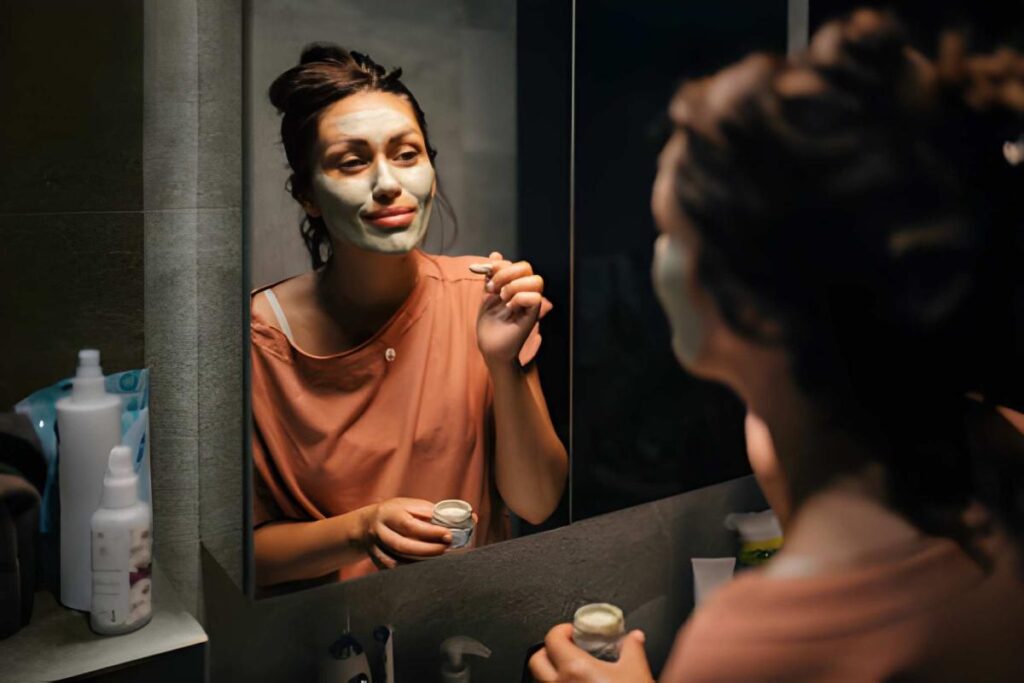
Most people devote more time to their morning routine than to their evening routine. This is a mistake. Your nighttime skincare routine is actually more important, as this is precisely when your skin is programmed to regenerate.
While you sleep, you reap the benefits of a skin treatment: increased collagen production, accelerated cell turnover, and skin repair. If you provide your skin with the right environment and products, you will wake up with a smoother, clearer, and more radiant complexion. We’ll explain exactly how to do it right.
Why Your Skin Works Better at Night
Here is a detail that most skincare advice tends to overlook: your skin possesses its own internal 24-hour clock, recognized as the circadian rhythm.
Various studies—presented to the American Academy of Dermatology by No7 Beauty and the University of Manchester—have demonstrated that the genes responsible for skin repair reach their peak activity between 2:00 and 4:00 a.m. At night, the skin barrier becomes more permeable, allowing it to absorb more active ingredients than in the morning.
Consequently, the routine you follow every night should go far beyond simply removing your makeup.
If you skip your nighttime routine, you leave behind—sitting on your skin all night long—pollution residue, sunscreen remnants, excess oil, and the oxidative stress accumulated throughout the day, thereby completely blocking your skin’s extraordinary repair cycle.
Nighttime Skincare Routine: Step-by-Step
Follow these steps, applying products from lightest to heaviest consistency. This is crucial: if you apply them in the wrong order, the absorption of each product will be compromised.
Step 1: Double Cleansing (Don’t Skip It)
Your first cleanse aims to remove any residue from the skin’s surface layer: sunscreen, makeup, excess oil, and environmental pollutants. Ideally, you should use a cleansing balm or an oil-based cleaner; apply it to dry skin and massage gently for 60 seconds. Rinse with warm water.
Your second cleanse goes deeper. Use a gentle, pH-balanced, water-based cleanser to remove sweat, residual dirt, and any other impurities that the first cleanse may have missed.
If you live in London, Mumbai, or Delhi, this two-step method is particularly beneficial, as your skin is exposed to significant levels of heavy environmental pollutants every night.
Step 2: Toner (Optional, but Very Useful)
A hydrating toner containing hyaluronic acid or *Centella asiatica* helps restore your skin’s pH to its optimal state after cleansing, thereby preparing it to absorb the products you apply next. This step isn’t strictly necessary, but it can provide relief if your skin feels tight or sensitive after cleansing.
Avoid using toners that contain alcohol. These compromise the skin’s protective barrier and negate all the benefits of the nourishing products you apply afterwards.
Step 3: Treatment Serum (Your targeted repair step)
Here, you will address your specific skin concerns. Choose one active ingredient per night and alternate as needed:
- Retinol or retinoids are ideal for anti-ageing, cell turnover, and pigmentation issues. Use two to three times a week initially, and gradually increase frequency if you are a beginner.
- Niacinamide treats blemishes, uneven pigmentation, and lack of radiance; it is suitable for skin concerns typical of Indian skin—such as post-inflammatory hyperpigmentation (PIH)—as well as those common in the UK, such as dehydration or clogged pores.
- Exfoliating Serum with AHA/BHA: smooths texture, removes dead skin cells, and helps unclog holes; use only 1 or 2 nights a week.
Do not combine retinol with acids on the same night. Doing so is a surefire way to damage your skin barrier.
Step 4: Eye Cream (If you use one)
The skin around the eyes is the thinnest on the face and has a lower density of sebaceous glands, meaning it tends to dry out faster and look more tired. To treat dark circles, puffiness, and fine lines under the eyes, an eye cream can make a visible difference with regular use; apply it using your ring finger (the one that exerts the least pressure).
Step 5: Nighttime Moisturiser or Overnight Mask
Seal in your treatment. Your night cream should be slightly richer than your daytime moisturizer; therefore, look for a formula containing ceramides, peptides, squalane, or hyaluronic acid. These ingredients work to repair your moisture barrier while you sleep, rather than simply sitting on the surface of the skin.
In the UK, during winter—when central heating and cold air strip the skin of moisture—using a thicker night cream or a weekly overnight treatment mask can make a noticeable difference by the next morning.
In India’s humid months, a gel-based nighttime moisturiser is usually sufficient. During the colder, drier winters (especially in Northern India), opt for a richer product.
Nighttime Skincare Tips That Make a Real Difference
Following the steps correctly is essential. And so is the context in which the routine is carried out.
- Perform your routine 20 to 30 minutes before going to bed; this allows the products to absorb before you lay your head on the pillow.
- Use clean pillowcases to prevent bacteria, oil, and product residue from accumulating in the fabric and transferring back onto your skin while you sleep. Silk or satin pillowcases are gentler on the skin and create less friction.
- Apply retinol while avoiding the eye contour area; use your specific eye cream for this sensitive zone.
- When it comes to active ingredients, less is more: do not irritate your skin barrier every single night. Alternate your nighttime treatments with a basic cleansing and moisturising routine, especially if you notice that your skin is reactive.
Common Mistakes in Your Nighttime Skincare Routine
Sleeping with sunscreen or makeup: Sunscreen is intended to sit on the skin and create a defensive film. Leaving it on overnight clogs pores and hinders the skin’s natural repair cycle.
Combining too many active ingredients: Using retinol, AHAs, and Vitamin C on the same night is a true nightmare for your skin barrier. You should alternate the use of these active ingredients on different nights, rather than including them all in the same routine.
Smearing products in the wrong order: A common mistake is applying thicker creams before serums, which prevents proper absorption. The ideal order—from lightest to thickest texture—is: toner, serum, eye cream, and moisturizer.
Rushing through your routine: If you are tired and try to complete every step in just 90 seconds, your products won’t absorb properly. Double cleansing alone deserves a full minute of massage. The products in your nighttime routine work much better when you take your time and don’t rush.
Myth vs. Reality: Nighttime Skincare Edition
| Myth | Fact |
| There’s no need to moisturise if your skin is greasy. | Oily skin still needs moistening. Don’t skip moisturising; lack of it means even more oiliness. |
| Sleeping masks are for dry skin only. | Most sleeping masks are suitable for all skin types; gel-based, lightweight formulas work perfectly for oily skin. |
| More products = better results | Your skin can take this far. Three lengthy steps are just as effective as eight quick ones. |
| You require a night cream; the day cream is quite sufficient | Night Creams do not include SPF and tend to contain more nourishing repair ingredients. Night creams have a totally different purpose. |
Skin Repair Routine by Concern
| Skin Concern | Key Night Ingredient | Frequency |
| Pigmentation / dark spots | Niacinamide, Alpha Arbutin | Every night |
| Dullness / uneven texture | AHA (glycolic or lactic acid) | 2–3x per week |
| Fine lines / anti-ageing | Retinol, Peptides | 2–3x per week |
| Dehydration / tight skin | Hyaluronic acid, Ceramides | Every night |
| Breakouts/congestion | BHA (salicylic acid), Niacinamide | Every night, or every other night |
Conclusion
Most breakthroughs in skincare don’t happen in the morning. They happen while you sleep—silently, steadily, every single night.
The truth is, you don’t really need ten products or an expensive collection of active ingredients. What you need is a nighttime skincare routine that you actually stick to: a double cleanse to wash away the day’s grime, a treatment serum for your specific concern, and a good moisturizer to keep your skin looking its best while you’re busy.
Starting tonight, simplify your routine. And don’t change it for 6 to 8 weeks.
Healthy, radiant skin isn’t built in front of the mirror in the morning; it’s built in the five minutes before you close your eyes.